THE DIVE · Free
THE DIVE - UNI (Uniswap)
Wad up grippers. Welcome to another edition of THE DIVE, a series where i break tokens down to the mechanics. No shilling, no fud. Today: $UNI from Uniswap.
Uniswap is the largest decentralized exchange by spot volume, the automated market maker that launched in 2018 and became the design most of DeFi copied. It's built by Uniswap Labs, a private New York company founded in 2018 by Hayden Adams, who is named the author on the UNIfication governance proposal. The protocol is immutable contracts, and UNI is the governance token over them, wrapped legally as DUNI, a Wyoming nonprofit association adopted 2025-09-09.
| Name | Network | Contract | Website | Category | MC |
|---|---|---|---|---|---|
| UNI | Ethereum | 0x1f9840a85d5af5bf1d1762f925bdaddc4201f984 | uniswap.org | DEX / AMM | $2.9B |
| - | Unichain | 0x8f187aa05619a017077f5308904739877ce9ea21 | - | - | - |
| - | Arbitrum One | 0xfa7f8980b0f1e64a2062791cc3b0871572f1f7f0 | - | - | - |
| - | Optimism | 0x6fd9d7ad17242c41f7131d257212c54a0e816691 | - | - | - |
| - | BNB Smart Chain | 0xbf5140a22578168fd562dccf235e5d43a02ce9b1 | - | - | - |
| - | Polygon PoS | 0xb33eaad8d922b1083446dc23f610c2567fb5180f | - | - | - |
| - | Avalanche | 0x8ebaf22b6f053dffeaf46f4dd9efa95d89ba8580 | - | - | - |
| - | Gnosis (xDai) | 0x4537e328bf7e4efa29d05caea260d7fe26af9d74 | - | - | - |
| - | Near (bridge factory) | 1f9840a85d5af5bf1d1762f925bdaddc4201f984.factory.bridge.near | - | - | - |
| - | Harmony | 0x90d81749da8867962c760414c1c25ec926e889b6 | - | - | - |
| - | Huobi ECO Chain | 0x22c54ce8321a4015740ee1109d9cbc25815c46e6 | - | - | - |
| - | Energi | 0x665b3a802979ec24e076c80025bff33c18eb6007 | - | - | - |
| - | Sora | 0x009be848df92a400da2f217256c88d1a9b1a0304f9b3e90991a67418e1d3b08c | - | - | - |
| Live: MC $2.9B · Price 4.73 · TVL $3.3B · Fees 24h $1.8M · updated 2026-11-24 12:14 UTC |
The Product
Four versions run at once. v1 (2018) is legacy, a plain constant-product pool. v2 keeps constant-product with one 0.30% fee tier. v3 moved to concentrated liquidity, where LPs pick price ranges and fee tiers. v4 (2025) is a rewrite around a singleton PoolManager and a hooks architecture that lets third-party contracts customize how a pool behaves. No order book, no matching engine anywhere in the stack; every swap fee is a pool parameter.
The scale: protocol TVL across all chains is $3.936B. Over 30 days the protocol did about $86.2B of spot volume, split v4 $42.49B, v3 $42.17B and v2 $1.55B, so v4 has now overtaken v3. Fees over the same window were $150.26M, with $3.52M in the last 24 hours. Uniswap sits on 46 chain entries by DefiLlama's count, largest Ethereum at $2.558B TVL, then Base $487.8M, Robinhood Chain $234.3M and Arbitrum $181.8M.
Two newer legs. Unichain is Uniswap's own OP Stack L2, live since February 2025 as a Stage 1 rollup, at $27.85M chain TVL and $310 of 24h chain fees on 2026-10-08. Uniswap also deployed v2, v3, v4 and UniswapX on Robinhood Chain at that chain's 2026-07-01 debut, crossing $6B cumulative swap volume by 2026-07-10, and on Arc, Circle's L1, at its 2026-09-16 launch.
The Tokenomics
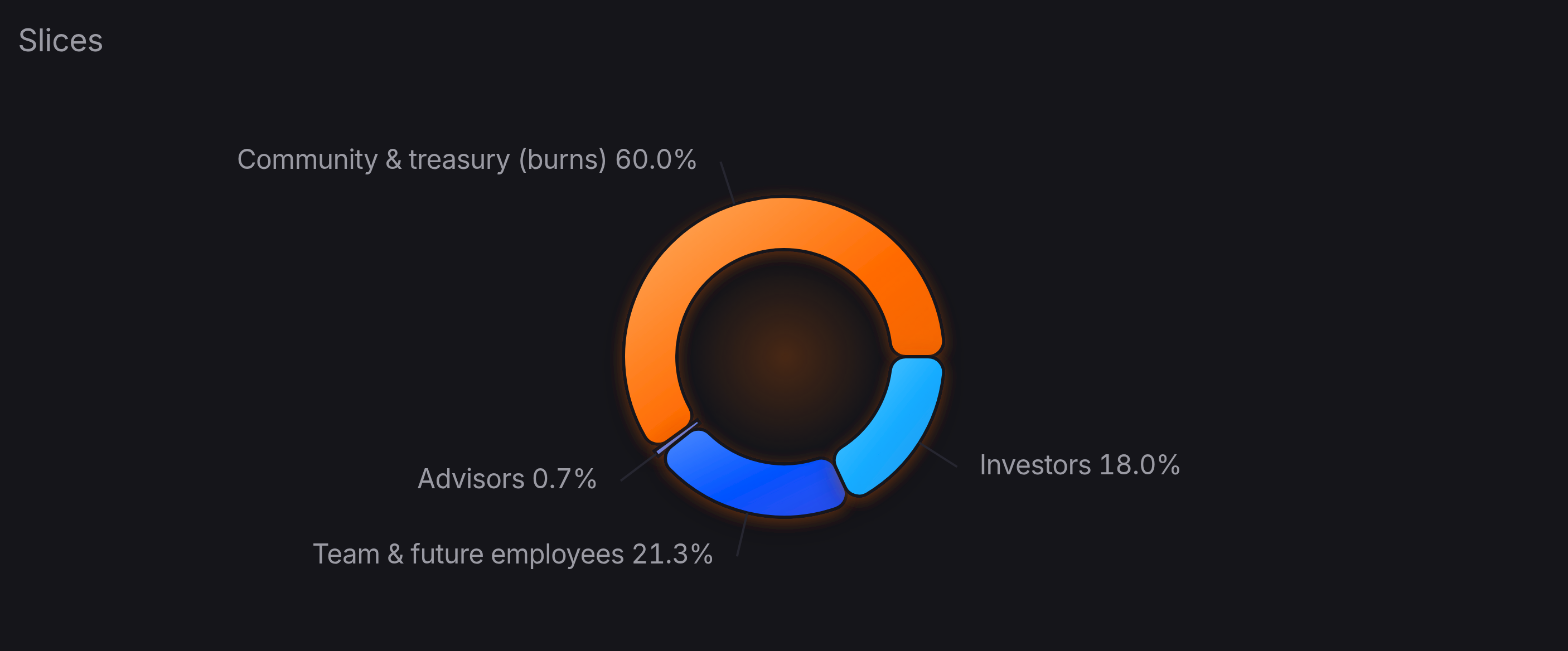
Allocation. 1,000,000,000 UNI minted at the 2020-09-16 genesis. The launch gave 60% to the community, of which 15% (150,000,000) was claimable in the airdrop and 43% (430,000,000) went to the governance treasury on a four-year release of 172M/129M/86M/43M per year. Team and future employees took 21.266% (212,660,000), investors 18.044% (180,440,000), advisors 0.69% (6,900,000), all on four-year vesting.
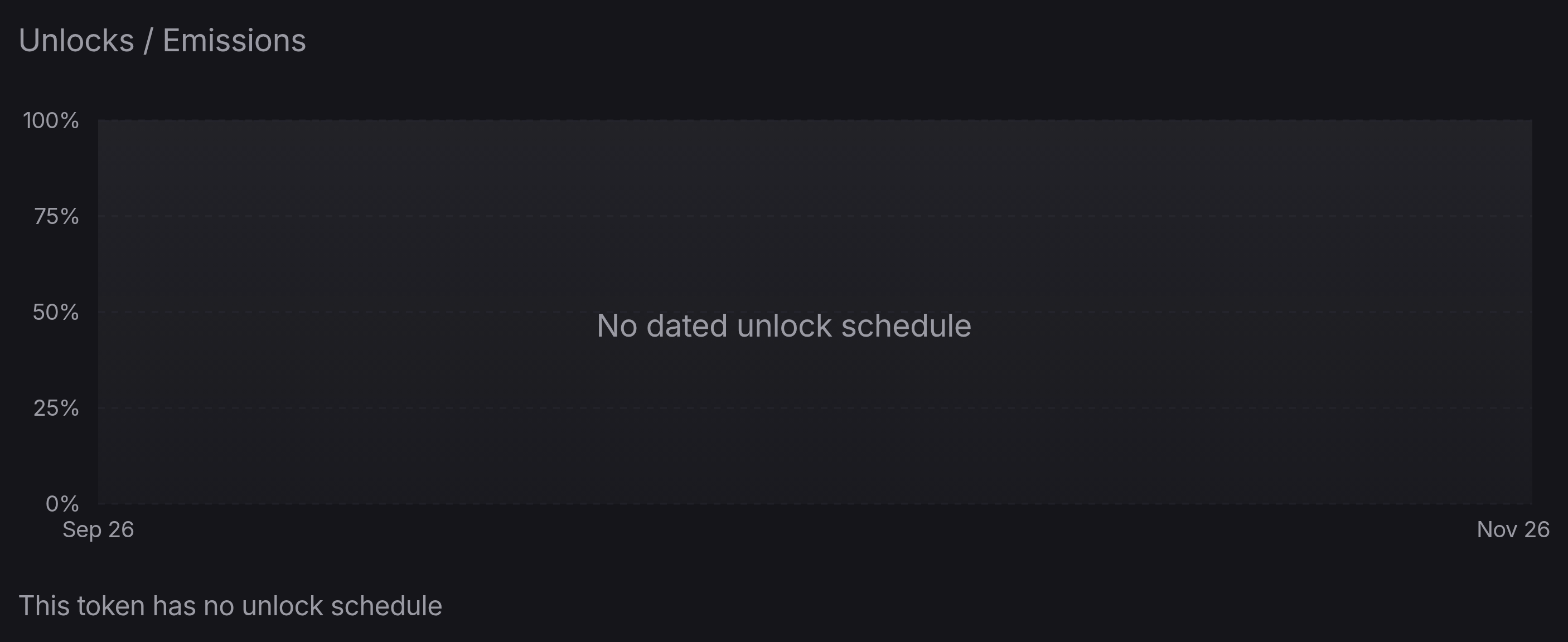
Unlocks and float. Fully vested. Every date-bound allocation finished by 2024-09-16 and there are no scheduled future unlock events. Supply only moves through burn or governance. On-chain the ERC-20 total supply is fixed at 1,000,000,000 UNI with no burn function, so burned supply is the 0xdEaD balance, now 112,717,581 UNI, 11.27% of 1B. The governance treasury holds 262,247,996 UNI, 26.22%. Aggregators report 625,038,422 UNI circulating, 62.50% of 1B, a $4.617B market cap and $6.554B FDV.
The Team
| Name | Role | Social |
|---|---|---|
| Hayden Adams | Founder, Uniswap Labs; UNIfication author | @haydenzadams |
| Ken Ng | Uniswap Foundation; UNIfication author | no public handle |
| Devin Walsh | Uniswap Foundation board | no public handle |
| Hart Lambur | Foundation board; UNIfication negotiator | @hal2001 |
| Callil Capuozzo | Foundation board | no public handle |
| Ben Jones | UNIfication services-agreement negotiator | no public handle |
The Foundation board after UNIfication is Devin Walsh, Hart Lambur, Ken Ng, Hayden Adams and Callil Capuozzo. The source material carries no personal social handles for these names, only their roles.
The Revenue
A share of swap fees is routed to the protocol and used to burn UNI. v2 splits its single 0.30% into 0.25% to LPs and 0.05% to the protocol. v3 routes one quarter of the fee on the 0.01% and 0.05% tiers and one sixth on the 0.30% and 1.00% tiers. v4 charges a protocol fee on top of the LP fee, capped at 0.10% of trade size. Trader-facing fees are unchanged; the switch moves the LP/protocol split.
The switch is on. Proposal 93, UNIfication, executed 2025-12-28 10:38 UTC, turned on v2 and v3 protocol fees on Ethereum and burned 100,000,000 UNI from the treasury in the same transaction. Fees then rolled out to 13 chains, and Proposal 100, executed 2026-07-27, activated v4 protocol fees on seven chains, with five more deferred to a later vote.
What reaches the token: fees accumulate in per-chain TokenJar contracts and can only leave if a searcher burns a fixed governance-set amount of their own UNI (4,000 on mainnet, 2,000 on L2s) through a Firepit contract to claim the jar. The protocol never buys UNI, so the burn is a step function of when claiming is profitable, not a straight line off revenue. Protocol revenue, the line tied to the burn, was $11.92M over 30 days and $55.44M all-time. Against that, UNIfication created a 20,000,000 UNI/year growth budget paid quarterly from the treasury.
The Risks
-
Burn versus budget: one community measurement put about 1.67M UNI per month paid to Labs against about 1.1M UNI per month burned as of 2026-07-16, so treasury units were leaving faster than the market burned them. An independent review put the realized fee burn at about 4-5M UNI per year against the same 20M UNI/year budget.
-
Burn cadence is a step function of searcher profitability, so the same fee flow supports fewer burns as UNI's price rises.
-
The fee switch cuts the LP share, v2 going from 0.30% all to LPs to 0.25%/0.05%, and some delegates opposed activating v4 fees before v4 had a dominant share of Uniswap volume.
-
Price is volatile: UNI fell 18.78% over 7 days into 2026-10-08 after rising 82.62% over 60 days and 94.91% over 200 days; the 90-day range is $3.175 to $10.880.
-
Exchange-held supply hit a record 113.9M UNI in late September 2026 per CryptoQuant, cited as potential sell pressure.
-
UNI confers governance rights, not a contractual claim on protocol revenue; accrual runs only through the burn path.
-
DUNI is a US taxpaying entity and UNI holders who govern are members, with disclosure and Wyoming Chancery Court dispute terms.
-
v4's fee adapter still shows $0 protocol revenue in the DefiLlama feed, so v4 protocol revenue relies on third-party on-chain trackers; single-day burn records also conflict across sources (186,000 versus 134,000 versus 106,000 UNI).
-
Unichain's burn contribution is small: $310 of 24h chain fees on 2026-10-08 against the roughly $7.5M annualized figure cited at UNIfication.
The thesis
-
The fee switch is on and burning. Proposal 93 executed 2025-12-28, turning on v2 and v3 protocol fees on Ethereum and burning 100,000,000 UNI in the same transaction; fees now run on 13 chains and v4 fees on seven since 2026-07-27. On-chain burn is 112,717,581 UNI, 11.27% of supply, and the route from volume to a smaller float is coded.
-
Supply is fixed and fully vested. 1,000,000,000 UNI at genesis, on-chain total_supply still 1e27, no mint ever executed, earliest permissible mint date 2024-01-01, and all vesting done by 2024-09-16. No unlock calendar is left to absorb.
-
Demand is dominance. About $86.21B of 30-day spot volume, roughly 28.4% of all tracked DEX volume, on $150.26M of 30-day fees. v4 did $42.49B and has overtaken v3's $42.17B, and v4's protocol fee charges on top of the LP fee.
-
Distribution is deep. Protocol TVL $3.936B, Ethereum $2.558B, Base $487.8M, Robinhood Chain $234.3M. Robinhood Chain crossed $6B cumulative volume by 2026-07-10 and Arc went live 2026-09-16.
-
The switch is not fully thrown. v4 fees are still off on five chains (Celo, Soneium, X Layer, World Chain, Zora), so the burn base can widen without any new product shipping.
The antithesis
-
The burn can shrink while fees grow. It is a step function, not a revenue line: the protocol never buys UNI, a searcher burns 4,000 on mainnet or 2,000 on L2s to claim a jar, and a higher price means the same $11.92M of 30-day revenue funds fewer burns.
-
If the budget keeps outrunning the burn, supply rises anyway. One measurement has about 1.67M UNI a month to Labs against about 1.1M UNI a month burned as of 2026-07-16.
-
LPs pay for the switch. v2 moved from 0.30% all to LPs to 0.25% LP and 0.05% protocol. Lose LP share and the volume the burn depends on moves venues.
-
There is no cash claim. UNI carries governance only, so all accrual runs through the burn path.
-
The legal wrapper has teeth. DUNI is a US taxpaying entity and members carry disclosure terms and a Wyoming Chancery Court class action waiver.
-
Measurement is a soft spot. v4 protocol revenue prints $0 in the aggregator feed, and single-day burn records conflict (186,000 vs 134,000 vs 106,000 UNI).
The whole value story is a burn that is live but small next to a 20M UNI/year budget, on a token that carries governance rights rather than a cash claim.
As always stay safe stay gripping.