THE DIVE · Free
THE DIVE: AAVE
Wad up grippers. Welcome to another edition of THE DIVE, a series where i break tokens down to the mechanics. No shilling, no fud. Today: $AAVE from @Aave.
Aave is a non-custodial, overcollateralized lending protocol. Suppliers deposit assets into pools and earn interest, borrowers draw against collateral and pay variable or stable rates. It began as ETHLend in 2017, rebranded to Aave, and is run by the Aave DAO, with Aave Labs (founder Stani Kulechov) as the original author and a DAO service provider.
| Name | Network | Contract | Website | Category | MC |
|---|---|---|---|---|---|
| AAVE | Ethereum | 0x7Fc66500c84A76Ad7e9c93437bFc5Ac33E2DDaE9 | aave.com | Lending | $1.5B |
Live: MC $1.5B · Price 95.05 · TVL $16.2B · Fees 24h $1.1M · updated 2026-11-24 12:14 UTC
The Product
Aave is the largest protocol in decentralized finance at about 60% share of lending. Live on 2026-10-08: $18.369B in deposits across the chains it runs on, $12.715B borrowed, and $423.19M staked in the safety system. Ethereum carries $15.318B of the $18.369B, about 83.4%.
Three versions are live. V3 holds $17.340B, V4 $654.4M and V2 $109.3M. V4 went live on Ethereum mainnet on 2026-03-30 under a hub-and-spoke architecture, with a Core Liquidity Hub feeding multiple Spokes. It launched on Avalanche on 2026-07-15 and was activated on Arc and Base during September 2026, including a Base Equities Hub that takes Coinbase-issued tokenized US tech equities as collateral, launched with about $29M of collateral capacity.
GHO, the native overcollateralized USD stablecoin, sits at $698.34M supply across Ethereum ($642.4M) and Monad ($56.6M), priced $0.9991. Insurance moved to Umbrella, an ERC-4626 vault system that slashes stakers in real time once bad debt in a specific asset passes a preset first-loss offset, with no vote and no delay.
The Tokenomics
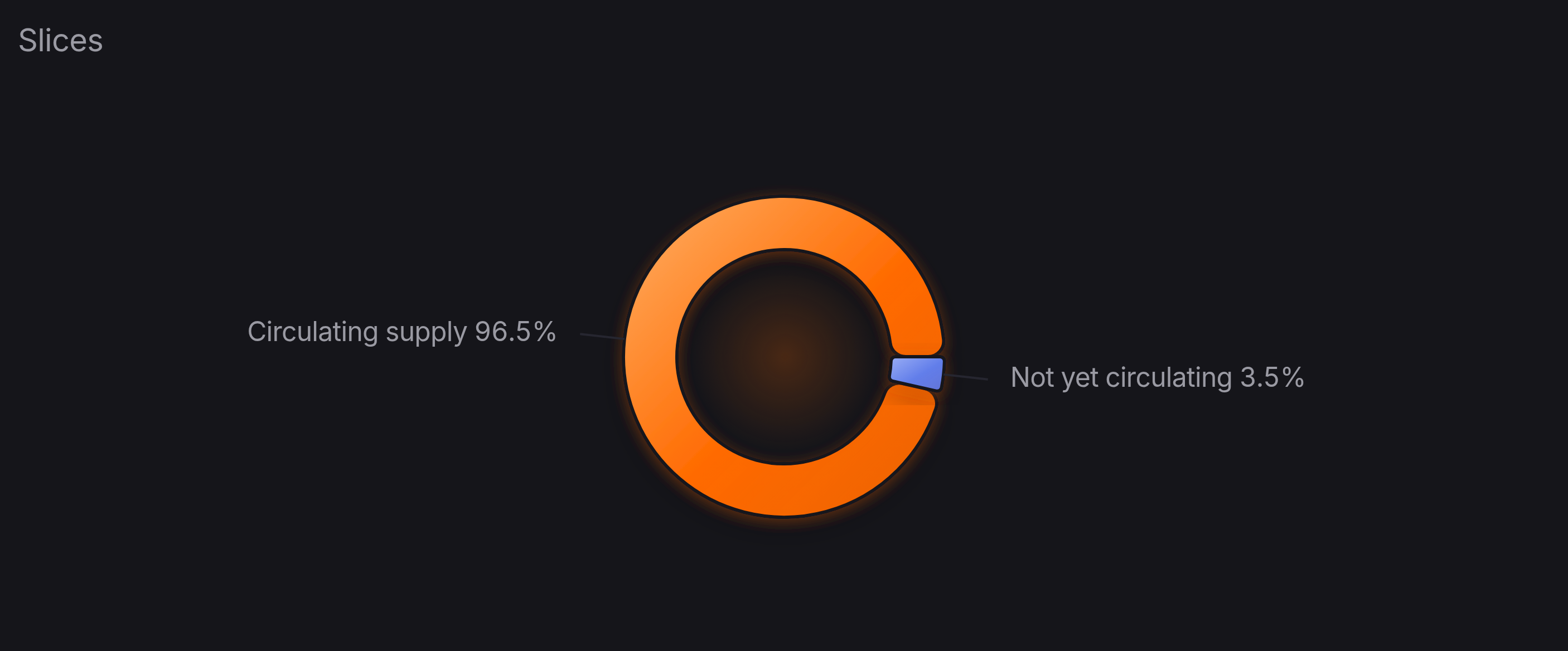
Allocation. Supply is fixed at 16,000,000 AAVE, with no inflation mechanism and no separate max-supply field. The token launched in October 2020 when LEND migrated to AAVE at 100:1, which is what set the cap. Aave did not republish a full category allocation table at the migration. The one primary figure available: the founding team and project retained 23% of the LEND supply at the 2017 ICO, converted at 100:1, and current founding AAVE holdings are not publicly disclosed.
Unlocks and float. AAVE has no token unlock schedule. Both CoinGecko and CoinMarketCap show 15,435,588.70 circulating, 96.47% of the 16M total, leaving about 564,411 AAVE (3.53%) not circulating. The only disclosed forward grant is under the Aave Will Win framework: the DAO approved about $25M in stablecoins plus 75,000 AAVE for Aave Labs, with the AAVE vesting linearly over 48 months.
The Team
| Name | Role | Social |
|---|---|---|
| Stani Kulechov | Founder and CEO, Aave Labs | @StaniKulechov |
| BGD Labs | Core protocol / governance-v3 developer | @bgdlabs |
| Aave Finance Committee | Chaos Labs, TokenLogic, LlamaRisk, ACI | governance.aave.com |
Aave Labs is the original author and now operates as a DAO service provider under the Aave Will Win framework. The DAO's service providers cover risk, finance and development.
The Revenue
Aave earns from the reserve factor on borrow interest, liquidation fees, flashloan and instant-liquidity fees, and interest on GHO minted against collateral. The DAO has controlled 100% of protocol fees since AIP-1, and under the Aave Will Win framework (AIP-469, April 2026) 100% of revenue from the Aave Protocol, GHO and Aave-branded products flows to the DAO treasury; Aave Labs has no direct claim on protocol revenue. The aave.com swap integration alone was cited at roughly $12M to $24M annually.
Over the 30 days to 2026-10-08, DefiLlama shows $37.84M of gross fees and $4.94M of protocol revenue, with all-time figures of $2.322B fees and $314.13M revenue. The gap between the two is depositor interest, which flows to suppliers.
What reaches the token is a buyback, not a burn. Governance approved a buyback in August 2024 and execution began April 2025, budgeted at $50M a year (cut to about $30M in March 2026), with weekly $250K to $1.75M purchases run by the four-member Aave Finance Committee. Bought tokens go to the DAO Ecosystem Reserve, where they can re-enter circulation, so they are not removed from supply. On-chain tracking shows $42.9M of AAVE bought all-time since 2025-04-09, including more than 205,000 AAVE (about 1.28%) for roughly $42M by February 2026 at about $205 average. Buybacks paused 2026-04-19 after the KelpDAO exploit, and Aavenomics 3.0 automation was reported activated 2026-06-27, but no on-chain purchases show since 2026-06-24 and DefiLlama's holders-revenue line is $0 over the trailing 30 days, so whether buybacks are running right now is unresolved. On 2026-09-29 founder Stani Kulechov said a burn is being considered for Aavenomics 3.0; there is no formal proposal, amount or date. AAVE rose more than 11% that day.
The Risks
- KelpDAO rsETH bad debt: on 2026-04-18 an attacker defeated KelpDAO's LayerZero bridge, released 116,500 unbacked rsETH (about $292M), deposited it as collateral on Aave V3 and V4, and borrowed roughly 82,650 WETH plus 821 wstETH (about $191M). Aave's bad-debt estimates range from $177M to $230M.
- Umbrella coverage gap: the aWETH vault was estimated at roughly $50M of coverage against $177M to $200M of bad debt, leaving an estimated $127M to $150M uncovered; Aave's own docs state a full recovery is not guaranteed.
- TVL concentration: Ethereum held $15.318B of the $18.369B total, about 83.4%, so Ethereum-specific collateral or oracle events dominate protocol risk.
- Revenue cyclicality: the March 2026 budget proposal cited January 2026 revenue of $7.95M against $13.5M a year earlier, down about 41%, and tied the buyback cut to a roughly 25% drop in borrow-fee revenue from its peak.
- Buyback execution: the reported Aavenomics 3.0 automation has no detectable on-chain purchases since 2026-06-24, and holders revenue is $0 over the trailing 30 days.
- V4 is early and small: $654.4M TVL and $1.84M of all-time fees, against $17.340B and $1.86B for V3.
- Chain consolidation: in July 2026 LlamaRisk recommended closing six V3 blockchain markets and offboarding about 50 low-use reserves.
- No net supply reduction from buybacks: repurchased AAVE goes to the DAO Ecosystem Reserve and can re-enter circulation; a burn was only considered on 2026-09-29.
- Slashing exposure: Umbrella can slash up to 100% of a vault after the first-loss offset, legacy stkAAVE and stkABPT carry up to 20% slashing exposure, and staked tokens lock for 20 days after a withdrawal request plus a two-day exit window.
- GHO scale: $698.34M supply is small relative to major stablecoins and depends on continued governance-managed facilitator caps and peg mechanisms.
- Regulatory history: Aave Labs self-funded a multi-year US SEC investigation and associated legal and compliance work; no outcome is stated in the reviewed sources.
The thesis
- Supply is capped at 16,000,000 AAVE with 96.47% already circulating, so there is no unlock overhang waiting on the book; the only forward grant on record is 75,000 AAVE (0.47% of supply) vesting linearly over 48 months to Aave Labs under AIP-469.
- Revenue reaches the DAO, not a middleman: $4.94M over the 30 days to 2026-10-08 and $314.13M all-time, with 100% of Aave Protocol, GHO and Aave-brand product revenue routed to the DAO treasury under Aave Will Win (AIP-469).
- The buyback is the only mechanic taking supply off the market, and it holds only while the flow runs: $42.9M bought all-time since 2025-04-09, more than 205,000 AAVE (about 1.28% of supply) by February 2026 at about $205 average, with the reported 2026-06-27 automation sized near 292 AAVE/day.
- Demand driver: GHO at $698.34M supply adds a second revenue line on top of the lending book, and the Base Equities Hub (about $29M collateral capacity, $21M USDC borrow cap) is a collateral type Aave did not have before September 2026.
- Distribution: $18.369B TVL, $12.715B borrowed and $423.19M staked across the safety system, spread over more than 20 chain deployments and quoted on non-Aave venues, so the token is not a single-market bet.
The antithesis
- Revenue concentration: Ethereum held $15.318B of the $18.369B TVL, about 83.4%, and V3 is $17.340B of the total, so the fee line is really one chain on one version; V4 at $654.4M TVL and $1.84M all-time fees is far too small to offset a stumble.
- Revenue cyclicality: the March 2026 budget proposal cited January 2026 revenue of $7.95M against $13.5M a year earlier, down about 41%, tied to a roughly 25% drop in borrow-fee revenue from its peak.
- The buyback may not be printing: no AAVE purchased on-chain since 2026-06-24 and $0 holders revenue over the trailing 30 days, so the one supply mechanic the case leans on may be idle right now.
- No net supply reduction even when it runs: repurchased AAVE goes to the Ecosystem Reserve and can re-enter circulation; the burn was only "considered" on 2026-09-29, no proposal.
- Mechanism risk: the 2026-04-18 KelpDAO rsETH bridge exploit (single 1-of-1 DVN) produced $177M to $230M of bad debt, against roughly $50M of aWETH Umbrella coverage, leaving an estimated $127M to $150M uncovered with no guaranteed full recovery.
- Substitute: Morpho at $11.164B TVL returned $0 of $19.51M in fees to holders because its fee switch is off, so it can undercut Aave on rate while Aave routes a share to the DAO.
Aave is the biggest venue in lending and its fee line is real, but the token's only supply mechanic is a buyback that parks tokens in a reserve and, on the latest on-chain read, has not printed a purchase since late June.
As always stay safe stay gripping.